
IS A DEMAND LETTER SO DEMANDING?
by
Robin Axtell, BSN, RN, LNCC
(Sources for this article are included in the Sidebar.)
As Legal Nurse Consultants (LNCs), you have heard the legal term DEMAND LETTER, but do you fully understand its purpose and what it contains? Did you know that as nurses, LNCs already possess the skills to participate in drafting these letters?
So, what is a Demand Letter? It is a formal document, often several pages in length, which is used during the presuit phase of a case. It strategically outlines the details of an incident, sets forth expectations for resolution, summarizes treatment and associated costs, specifies payments being requested, and serves as a final effort to resolve a dispute between two parties before litigation. Because most of the demand letter is medically based, the LNC’s skills in record analysis, medical chronologies, billing review, identification of standards of care, and interpretation of treatment can play a key role in building a strong, well supported demand. This can save attorneys and legal staff valuable time. For the purpose of this article, the focus will be demand letters commonly used in personal injury cases; however, demand letters are also utilized in Business & Commercial Law, Intellectual Property, Real Estate & Landlord-Tenant, and Employment Law.
Personal injury claims arise when one party [plaintiff] is injured due to the actions or negligence of another party [defendant]. The plaintiff attorney represents the injured party, and the demand letter is directed to the defendant’s insurance company such as an auto carrier or commercial liability insurer. While formats may vary between law firms, the key components are typically the same. Understanding these components helps LNCs recognize where their expertise supports case development. So, let us break it down.
LIABILITY
The liability explains how the incident occurred and why the defendant is responsible. It typically includes a factual timeline of the events and supporting evidence, and references applicable citations or even laws and standards depending on what type of claim is being pursued. For example if this was an auto accident we might see something drafted such as:
On February 2, 2026, Ms. Jane Doe was the restrained driver of a 2015 Kia K5 traveling on I-95 and stopped with traffic. The roads were dry and conditions clear. Your insured driver, Mr. John Smith, was traveling behind my client and failed to note traffic patterns and caused the rear-end collision. Witnesses at the scene reported Ms. Doe had been stopped for several seconds prior to the crash. Due to noticeable laceration above the right eye and reported neck pain, Rescue #14 [County] responded to the scene and determined Ms. Doe needed further medical care and transported her with a cervical collar in place to Sideways Hospital for further evaluation and treatment. Enclosed please find the crash report citing your insured with Careless Driving (citation #…).”
The liability section can be as detailed as possible and if you are computer savvy, importing the drawing of the accident from the crash report or scene of the incident into the letter is a great tactic. If the photographs are decent, (i.e., property damage that is visible or a wet floor where someone fell) those could be included as well as attachments.
If you have the opportunity to review the accident report or incident report, take note of the details, especially mechanism of injury. What happened on impact? Was the injured party thrown forward and backward in a whipping motion? Did they strike their head or body anywhere in the vehicle or against the floor if a fall case? Victims can suffer axonal shearing of the brain by acceleration/deceleration maneuvers and/or from striking the back of their head against the headrest. Keep in mind, symptoms and injuries are ongoing and not always known immediately. Consider the concept of shaking a snow globe and the time it takes for all the particles to settle back down. The same happens when someone is injured.
INJURIES AND TREATMENT
The core of a persuasive demand letter lies in the clinical documentation. This is where the LNC shines. Rather than simply an attorney stating, “please find enclosed the medical records and bills” and leaving it to the insurance adjusters to determine what is relevant-which often occurs- this is where the LNC’s skills, knowledge, and clinical education truly shine. Who better to identify, organize, and highlight the most medically relevant information than an LNC. Not only will this save the law firm staff time, but the LNC’s comprehensive summary will most certainly place a higher value on the claim. I can assure you, if you are already providing medical summaries to a law firm, they are cutting and pasting it right into their demand letters – or they should be.
While the LNC’s focus will be on the medical portion, most insurance companies utilize some type of software system that calculates settlement offers based on the information provided in the letter. The LNC does not just summarize, but also identifies “value drivers” and translates dense clinical jargon into a persuasive narrative. To ensure the software’s algorithm recognizes the true severity of the claim, the LNC will ensure the Demand fully discloses:
- The severity of the injuries and treatment, including ICD 10 and CPT Codes;
- The client’s Maximum Medical Improvement (MMI) status;
- If the client sustained a permanent injury;
- Was there a documented impairment rating; and
- Is there a foreseeable need for future care.
The adjusters who review the medical information may have no medical training and by connecting the mechanism of injury directly to the diagnostic findings and clinical findings and treatment, the LNC helps eliminate any gray area that insurance adjusters use to deny or devalue the claim.
MEDICAL EXPENSES AND BILLING SUMMARY
Medical expenses may or may not be listed directly in a Demand Letter. If the medical expenses are substantial it is common to see them in the letter. Otherwise, a separate attachment is included that outlines the medical expenses. Regardless of the format, the LNC provides essential clarity by synthesizing these costs into a comprehensive billing ledger (Often in MS Excel or Word). This summary tracks every provider, total charges, insurance adjustments, and outstanding balances. By auditing medical bills against health insurance liens and payout ledger, the LNC identifies missing documentation and filters out unrelated charges. Obtaining an expert review of ICD and CPT codes can ensure that only claim-relevant expenses are included, and provide a robust foundation for settlement negotiations or disputes.
LOST WAGES AND ECONOMIC DAMAGES
Significant injuries often result in immediate income loss and long-term economic impact. This section details those financial losses, typically supported by employer verification letters or tax returns demonstrating diminished profits. The LNC may review the records for verification that a physician has indeed placed the client out of work or indicated certain restrictions, such as light duty, if they were to return to work. If the injuries prevent the client from returning to work or returning to the same type of work, there could be a claim for loss of future earning capacity. Additional economic damages include property loss (vehicle repair or replacement), necessary medical equipment, home modifications, and travel expenses related to medical treatment.
PAIN AND SUFFERING/NON-ECONOMIC DAMAGES
While often omitted in standard demand letters, a detailed analysis of non-economic damages can significantly elevate a claim’s value. LNCs specialize in humanizing the medical data by documenting the profound impact an injury has on a client’s daily life. We look beyond the charts to identify “Duties Under Duress.” These are activities the client must continue to perform, despite physical limitations or pain caused by their injuries. The LNC’s investigation will include:
- Has there been any lifestyle disruption from the pain and function loss and disruption of normal routine?
- Are there any long term limitations?
- Has there been a psychological impact (i.e., emotional distress, depression, PTSD, loss of injoyment of life)?
- Do they have a permanent disfigurement (scarring, loss of limb, etc.)?
- Are there family members, friends, or witnesses who provide a statement or affidavit detailing the changes noticed in the client’s personality or lifestyle?
EVALUATION OF THE CLAIM OR DEMAND TO SETTLEMENT
Following the above information, the Evaluation of the Claim is the critical juncture where the attorney established the settlement valuation and sets the definitive deadline for the insurer to respond and avoid litigation. While the attorney determines the final demand amount, the LNC provides the essential framework, ensuring the medical evidence is robust, organized, and strategically defensible. Should the parties fail to reach an agreement, this evaluation serves as the foundation for the decision to move the claim into active litigation.
CONCLUSION
Mastering the art of the Demand letter elevates the LNC’s role from a consultant to a strategic partner. By turning complex medical evidence into a strategic legal document, the LNC does not just offer expertise, but streamlines operations and maximizes case productivity. Once again, our value as Legal Nurse Consultants becomes truly indispensable.
(Sources for this article are included in the Side Bar.)
Author: Robin Axtell, BSN, RN, LNCC
Email: rmaxtell@aol.com
_________________________________________________________________________________
CHAPTER MEMBER HIGHLIGHT
REGINA JOHNSON, MHA, BSN, RN

Regina Johnson, MHA, BSN, RN, is a legal nurse consultant and the founder of A.C.E. Legal Nurse Consulting, LLC, which she launched in 2025. She has been a nurse for nine years, with clinical experience in the emergency department, intensive care unit, and as a nursing supervisor in primary care. Her background in fast-paced, high-acuity environments gives her a practical understanding of how medical decisions are made, documented, and communicated across healthcare teams.
Today, Regina brings that clinical perspective to the legal field, assisting medical malpractice and personal injury attorneys with medical record analysis, timelines, and case evaluation. She enjoys helping legal professionals make sense of complex healthcare documentation and identifying the medical facts that matter most in a case. When she’s not reviewing records, Regina enjoys being involved with the Greater Orlando Chapter and connecting with other nurses and legal professionals.
Regina can be reached at: regina@acenurseconsulting.com
_______________________________________________________________________________
ABOUT THE GREATER ORLANDO CHAPTER OF AALNC
The American Association of Legal Nurse Consultants (AALNC) was founded in 1989, as a not for profit membership organization dedicated to the professional enhancement and growth of registered nurses practicing in the specialty of legal nurse consulting. Chapter development quickly followed. The Orlando community was rich with nurses already practicing in the field of legal nursing. This group of committed professionals quickly became members of the new national organization and recognized the need for a local chapter. The Greater Orlando Chapter of AALNC, founded in 1990, was the second chapter formed under the new national organization. The Chapter was begun in support of AALNC’s mission, by providing networking opportunities, mentoring and support to nurses through professional development and education – a mission that continues today.
______________________________________________________________
CONNECT WITH US
Connect with us on LinkedIn
Check us out at: https://orlandoaalnc.org
Contact us at: info@orlandoaalnc.org

Resources for “Is a Demand Letter so Demanding?”
1. Attorney resources. AALNC. (2025, October 27.) https://aalnc.org/attorney-resources/
2. Robinson, M. (2026, January 22). Strategies and tips for writing a personal injury demand letter. Clio. https://www.clio.com/blog/personal-injury-demand-letter/
3. How ICD and CPT codes strengthen settlement demand letters for personal injury cases – trivent legal. (n.d.). https://triventlegal.com/blogs/how-icd-and-cpt-codes-strengthen-settlement-demand-letters-for-personal-injury-cases/
__________________________________

IT’S TIME TO PACK YOUR BAGS FOR ORLANDO!
AALNC Annual Forum is going to be a live event again in 2026, and it will be in BEAUTIFUL Orlando! AALNC has partnered with AANLCP for what promises to be a Forum for the record books! PreForum will include a Mock Trial, which is a great learning experience for all – the attendees AND the LNCs serving in the various roles!
The Greater Orlando Chapter is hosting a HAPPY HOUR from 5:00 – 6:00 On Thursday evening, just find your way to the LNC Connection Corner for fun and networking! And be sure to stop by the Chapter table to sign up for some awesome give-aways, AND to say hello and introduce yourselves!
Go to https://www.aalnc.org/Events/AALNC-Annual-Forum for more information and to register.
_______________________________
CALENDAR OF EVENTS

Be sure to check out the AALNC calendar of events, which includes MANY events, presented by ALL of the AALNC Chapters and by AALNC! You can fill your calendars for all of 2026! And mark your calendars for the 2026 Greater Orlando Chapter Update and CE Webinars.
- April 21, 2026 – “Dysphagia, Swallowing Stages, Cognition, Dementia – Case Study”, presented by Elizabeth McKinley, MA, CCC/SLP.
- May 19, 2026 – “End of Life Directives,” presented by Matthew Garvey, DNP, MBA, RN.
- June/July 2026 – SUMMER BREAK
- August 18, 2026 – Presentation on Mass Torts, by Jennifer Scheuer, MSN, RN, LNCC.
- September 15, 2026 – Presentation on Chemo and toxic effects, by Lakeisha Falwell, MS, NP, RN, AOCNP.
- October 20, 2026 – “The Role of the LNC in Child Abuse Cases – Head Trauma…Part II”, presented by Beth Brant, DNP, APRN, LSN, CPNP-PC, NCSN-E, MCP-C, LNCC.
- November 17, 2026 – “Child Abuse – Munchausen Syndrome,” presented by Jordyn Hope, BSW
Don’t forget our On-Demand Webinars. We have 22 On-Demand Webinars which are free for Chapter members and only $20 for non-Chapter members.
And check out the education programs from our fellow AALNC Chapters:
- Bay Area Chapter of Northern California at: https://www.bacnc.org/
- New Jersey Chapter at: https://aalncnjchapter.clubexpress.com/
- Pittsburgh Chapter at: https://aalncpittsburgh.org/
- Tampa Bay Chapter at: https://www.aalnctampa.com/
- Pacific Northwest Chapter at: https://www.pnw-aalnc.com/
CONTINUING EDUCATION INFO
The Greater Orlando Chapter of AALNC is an approved provider of Nursing CE through the Florida Board of Nursing and CE Broker, and approved by the following States: Arkansas, District of Columbia, Florida, Georgia, Kansas, Mississippi, New Mexico, South Carolina, Tennessee, and West Virginia. We report CE directly to CE Broker in these states. For attendees from other States, we provide required documents for self-reporting CE to State Boards of Nursing.
____________________________________
LNC LAUNCHPAD – Q&A with Greater Orlando Chapter LNCs
In 2021 we started a new program for members, which we call “LNC Launchpad – Q&A with Greater Orlando Chapter LNCs.” This is a 1.5 hour session to provide guidance, answer questions, and suggestions. We limit the event to 10 participants, so we can mentor each attendee – whether new to the LNC practice or experienced and ready for a change – we are there for you! We completed our first 2026 session on February 10th. Below are the remaining dates for 2026. Registration opens about 2 weeks before each session, so check our website often.
- May 12, 2026
- September 8, 2026
- November 10, 2026
______________________________
A BLAST FROM THE PAST!
This is the heading of the FIRST Volume of our FIRST Chapter Newsletter – Before We changed the Name…
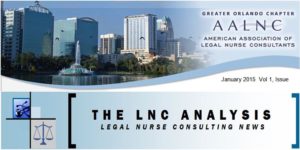
In 2018 we changed the name of our Newsletter from The LNC Analysis, to From the President’s Desk… Since that first publication in January 2015, we’ve published almost 30 Newsletters, 20 of which are available on our website. Our newsletters are available to non-members for free – no login required. So feel free to share them with your clients/attorneys! They can just go to https://orlandoaalnc.org/news/ view them all.
MEET THE 2026 GREATER ORLANDO CHAPTER OFFICERS & DIRECTORS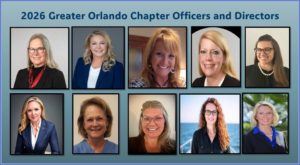
President: Michelle Gaines, MNA, RN, CRNA
President Elect: Jenelle Lea, MBA, BSN, RN, CEN, GFN-C
Immediate Past President: Robin Axtell, BSN, RN, LNCC
Secretary: Lori Mollmann, MBA, BSN, RN
Treasurer: Jillian Talento, BSN, RN, CEN, LNCC
DAL: Pamela Borello, BSN, RN, CNOR, CNAMB, CSSM(e)
DAL: Jill Campbell, BSN, RN, CPTC
DAL: Deborah Watkins, MHL, MSN, RN, CCM, CRRN, CLCP, MSCC, LNCC
DAL: Letitia “Tish” Baggett, BS, BSN, RN, CCM, CLNC, FIG LCP-C
DAL: Rebecca Edwards, MSN, BS, RN, EMT-P
__________________________________